


Poor rural communities are held back economically and silenced politically by denying them internet access. The lack of connectivity makes it hard for them to access online education, learn about medical resources, and look for work during COVID-19.
Money and power are at play. Large phone companies profit from not investing to build rural internet services and charge high prices for the access they do offer. Politicians benefit from donations from the phone companies to stay in office. The lack of connectivity disenfranchises rural voters by making it harder for them to learn about candidates, register to vote, find details on voting locations and request rides to the polls.
Organizers struggle to connect with disconnected rural voters and mobilize them to vote. Online ads, email, Facebook posts, tweets, text messages don’t work without internet and cellular coverage. Voicebots and affordable WiFi can empower rural communities – both politically and economically.
This blog covers:
- Talk to a voicebot yourself and find an early voting polling location
- Challenges in mobilizing rural voters without internet and cellular connectivity
- Why Black voters in rural communities are often overlooked how to reach them
- How Reclaim Our Vote mobilizes rural Georgia voters using voicebots
- How voicebots work and the need for frugal innovation
- Affordable options for rural communities to set up local WiFi hotspots

Imagine you are a poor and live in a rural county in Georgia with no access to the internet or cell coverage. You want to vote, and need to find your voting location and when it is open. What do you do? Call 678-679-2405 and just say your county name and zip code. A bot tells gives you the answer right away.
Try it for yourself by calling 678-679-2405. Choose one of the counties and zip codes from this table for this exercise.


Background
“Statewide, a third of rural Georgians are people of color. The Black Belt was historically an agricultural region that remains starved for economic development, and the class and power divide that began during slavery still persists along racial lines in many communities. It’s a black population that has been mistreated and marginalized by the political system.” – VOA
This map shows how rural communities are denied connectivity which keeps them impoverished and makes it harder for them to vote.

Reclaim Our Vote
Reclaim Our Vote is a campaign of the Center for Common Ground a non-partisan 501(c)(3) organization. It empowers under-represented voters to fully participate in elections by providing voters education on how to monitor voter registration status, find voting locations (vote centers, dropboxes and voting precincts) and county contacts for local boards of elections or registrars. It also builds technology to empower local communities long after elections are over.
Andrea Miller, Reclaim Our Vote
Landline phones and voicebots
Traditional approaches such as emails, text messages and mobile ads do not work in rural areas without internet and cell coverage. A landline phone is often all that is available for communication. Responding to phone calls manually or with an answering machines is slow, labor intensive and costly.
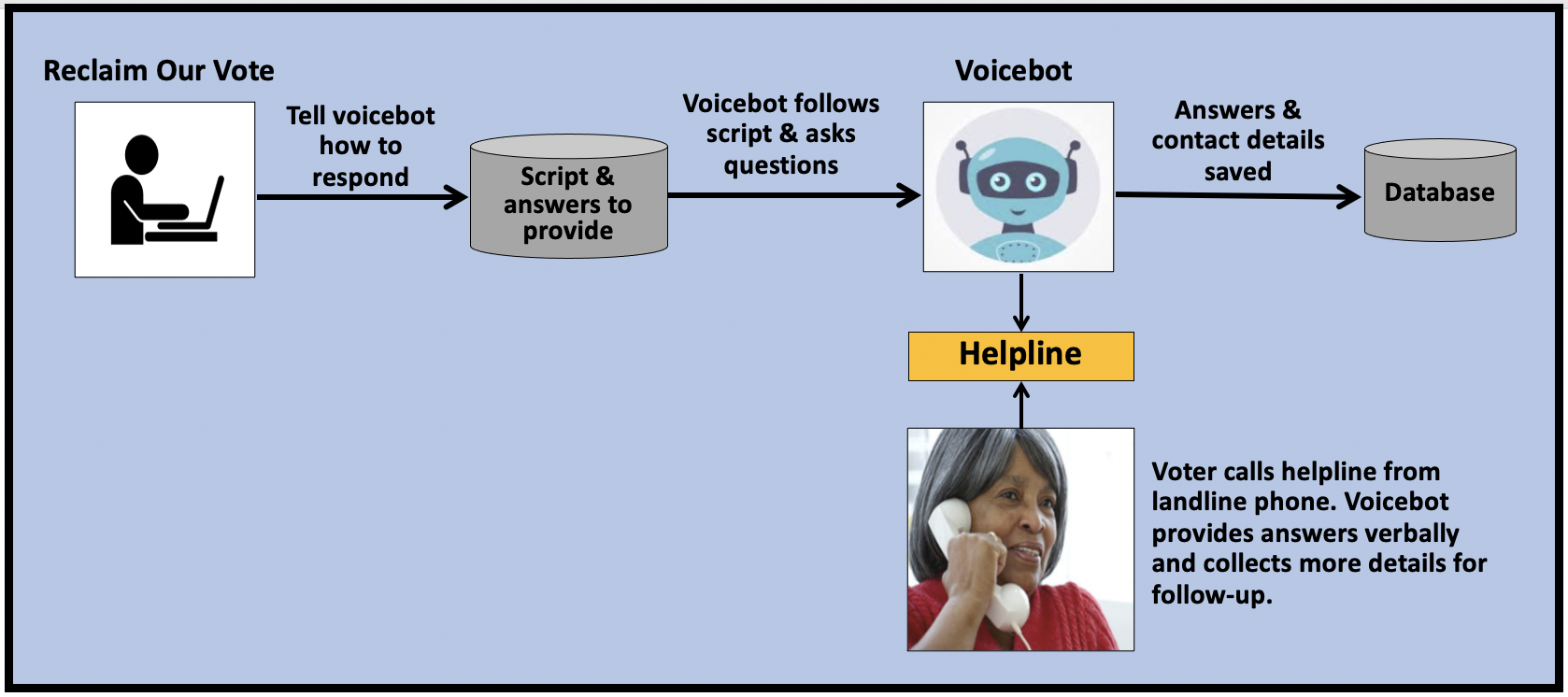
Voicebots on the other hand, are affordable and can deal with a large number of calls at the same time. Voicebots understand what the caller is saying, ask questions to collect details, lookup the answer and reply verbally to the caller. They also transcribe the conversation and save that information for further follow up. The ROV voicebot is built on Twilio and configured to provide information to rural voters calling from landline phones.
The voicebot asks the caller for their county and zip code. It converts what they said into text and uses that to search a database of polling locations. The voicebot then reads out the answer to the caller. This type of look up uses a proximity search based on Google Map API.
Voicebots work with landline phone calls to help organizers overcome the isolation and disenfranchisement of rural voters. They are affordable and cost a few hundred dollars to set up and a few cents for every call they handle. Learn more here.
The need for rural broadband internet
It is a vicious cycle. Poor rural voters have less political clout as it is harder for them to vote. Lack of political clout denies them the power to break the profitable monopolies that cable companies have by not building internet capacity in rural areas and charging a lot for what access they do offer. Political donations from the phone companies help preserve their stranglehold over rural communities.
Here are two affordable providers of internet access to rural communities:
CALYX Institute – Unlimited 4G Internet and a full year of unlimited Wi-Fi data and hotspot hardware for $50/month. The group does wonderful work in bridge the digital divide in many underserved areas and communities.
VOQAL – Bridges the digital divide by making sure everyone has access to the power that the internet and digital communication provide. Through Mobile Citizen, it has established the first 4G service provider in the U.S. to offer affordable mobile internet exclusively to education and nonprofit organizations.
Frugal innovation
Technologies such as voicebots are affordable and widely used in business. Why aren’t they more widely used in progressive organizing? More communication between grassroots groups who understand the needs of the communities they serve and technologists to develop solutions is needed. Using existing apps helps cut the cost and time needed to develop solutions. The effort is highly leveraged because the same solution benefits other groups as well. This voicebot to serve rural voters in Georgia, for instance was built by DemLabs for Reclaim Our Vote $900 in four days using the existing Twilio platform.
TakeAway: It’s time to break the stranglehold that monopoly phone companies have over rural communities by denying them connectivity. Voicebots and affordable internet access provide poor, rural communities a political voice and means to advocate for themselves. Support Reclaim Our Vote in frugal innovation.
Deepak
DemLabs
Recent Articles:
- Mobilize poor, rural voters without internet or cell coverage using VOICEBOTS
- How BLUE FUTURE uses textbots to mobilize young voters in Georgia
- Who profits from denying internet access to rural America?
- Zoom performance anxiety? Follow these expert tips.
- Voting in Georgia? Map of early voting locations.
- Vaccinate against disinformation
DemLabs is a project of the Advocacy Fund


