


Issue needing attention? Try mischief!
Need media exposure for your cause? Listen to The Yes Men.
How do grassroots groups move public opinion with few resources and little time? Protest creatively to get free media coverage for your cause.
Learn the secrets to all of the Yes Men hijinks,* and then work with them to pull off your own. Or watch movies, read rants, browse around, or find out why they did what.
The YesMen have worked with activist orgs and students for over two decades to get mainstream press with tactics such as:
- Impersonating nefarious entities — to communicate what they really mean.
- Creating public illusions — made people think something was happening that wasn’t, quite — in order to raise the question: “why not?”
- Working with impacted communities — sometimes not just getting press, but turning “stakeholders” into activists.
- Destroying brands — and now, if you look for them, you find nothing but criticism.
- Disrupting events — to expose the weakness of the “powers that be” and the depths of our delusion about them.
- Doing near-instant actions — making a splash in less than 24 hours, and sometimes in just a few minutes.
Watch the video
Ideas for a good action
- It evokes reactions in your audience by pushing them out of their comfort zone.
- It makes you cringe. Tasteless ideas are often the best ones. Don’t reject them!
- It makes you laugh or experience a strong emotion—a sure sign it’ll do that for others.
- It hasn’t been done—at least not exactly like this.
- It should make a bit of sense. A bit is enough; more important is for it to make you laugh or cringe!
For nonprofits with “issue” campaigns, trickery can often help get information out to the public, by giving journalists an excuse to write about critical things they couldn’t ordinarily cover “just” because they’re important. Here are some good resources.
- Actipedia: a giant, user-generated, user-ranked, and searchable database of creative activist projects.
- Beautiful Trouble: a more curated list of case studies, principles, tactics, and theories.
Designing a campaign
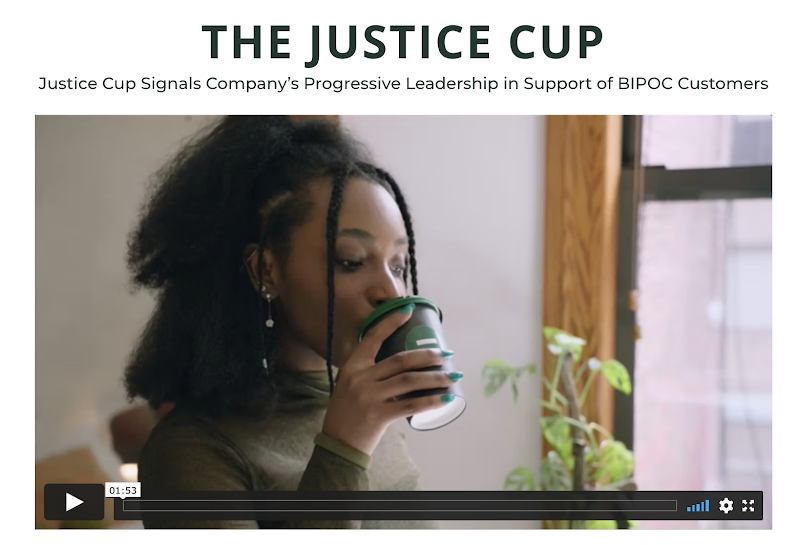
“Under the right conditions, progressive activists have used all sorts of trickery to make disproportionate waves in the media around anti-corporate, social justice, and environmental issues. Recently a group of vegan activists decided to target Starbucks for charging extra for plant-based milks, and approached the Yes Men for help using trickster techniques. They adapted a Yes Men project, Coal Cares, in which the coal industry announced they were fixing coal-caused childhood asthma by providing free decorated inhalers to children — but we’d make it more positive. Ta-da, StarbucksCares!”

Use press releases
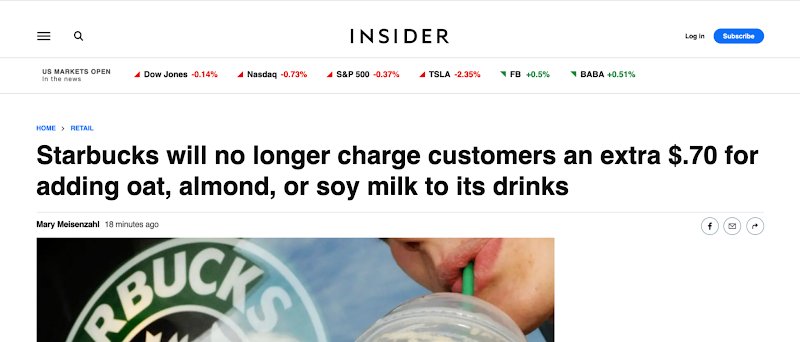
“Switch4Good was opposed to dairy for the usual environmental, ethical, and climate-change reasons, but for this project we chose a new angle to highlight: since only people of Northern European extraction can mostly tolerate dairy, charging extra for plant-based milk constitutes ‘dietary racism‘. We felt that this argument, being novel, would be ‘stickier’, since the media always needs something new.
‘Our hoax began with ‘Starbucks’ acknowledging the prevalence of lactose intolerance among everyone except whites. “Did you know that the milk we drink is tearing us apart?” said the narrator of our video — before announcing ‘Starbucks’s decision to drop plant-milk surcharges and to charge more for dairy instead, as a way of ‘bringing us together.’ The video accompanied a press release sent to thousands of journalists. The calibre of the writing, as well as the concept’s credibility, meant that Business Insider and four other outlets fell for the hoax. Just as importantly, the campaign spread the new concept of dietary racism.”

Key takeaways from a successful hoax
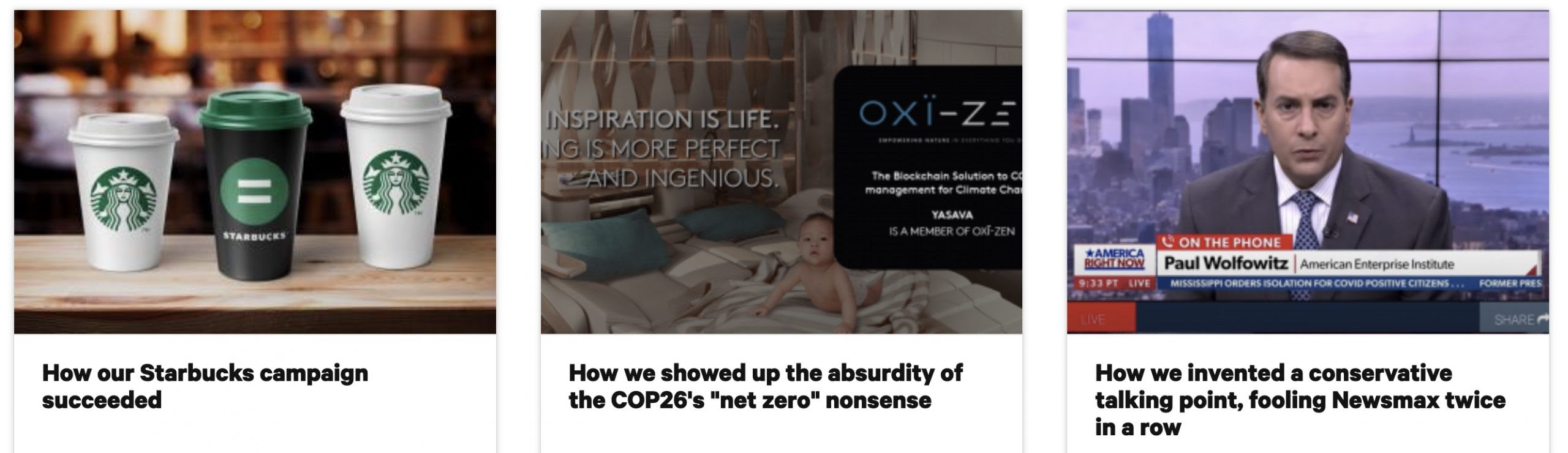
Just as Starbucks was starting to react, we sent out a fake denial on their behalf, awkwardly admitting the (true) fact that ‘Starbucks… have known about ethnicity-related lactose intolerance for many years‘ but asserting (accurately) that ‘changing our pricing policy… is not in our racial-equity plans, nor will it be.’ Finally, an hour later, we issued a ‘reveal‘ release, informing everyone of the hoax and the reasons we’d done it. Dozens of outlets covered the hoax, raising thorny issues for Starbucks — so thorny they caved, at least in the UK.” – Yes Men. Why did this stunt work?
- The activists had a motivated, talented, and creative team, as well as a fearless leader
- They had a clear, achievable ask — for Starbucks to drop plant-milk surcharges
- They even had a new angle on the issue, that hadn’t gotten much exposure
- They chose a good target, since Starbucks wants to be seen as progressive and is this vulnerable to attack from the left

Yes Men advice
“Such things might be barely known to the public (like, in 2004, Dow Chemical’s acquisition of mass-death-causing Union Carbide), or they might be pretty well known already, but needing an extra bump up in the media (like New York’s racist policing practices).
Unlike unscrupulous liars we’re all very familiar with, the point of Yes-Men-style projects is never to fool anyone for very long — our Three Strikes You’re In project, for example, fooled no one and yet made mainstream TV. Briefly fooling one outlet of stature, like Business Insider, can help amuse other journalists when we later reveal the hoax — but the goal is always to get new true information out there. This also serves the goals of journalism, so most journalists tend not to mind a bit of theatrical humor along the way — even when they themselves have been tricked!
If, however, you’re promoting or attacking a political candidate, you probably shouldn’t use tricky techniques. The notion of trickery has been so thoroughly discredited by conservative forces and politicians that ‘trickery for good’ is now impossible in politics, and insisting ‘our’ version is different will surely come off as a nicety.
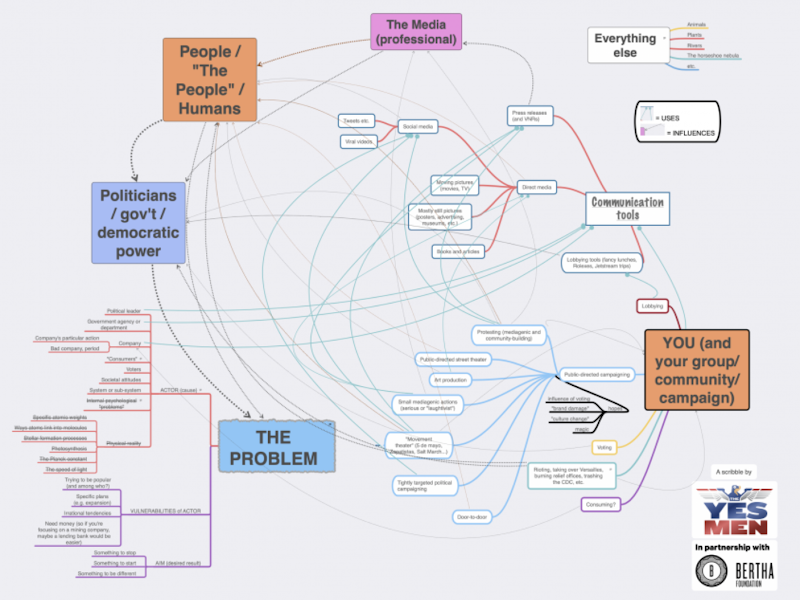
“We made the below diagram (and walk-through) to help you think through how a mischievous issue campaign — or any such campaign, really — can help create change within a democracy. In short, media attention affects public opinion, which in a democracy influences corporate or government behavior. It can even, in the very best cases, help to change culture or (even!) the law.” – The Yes Men

Answers from the Yes Men
- “Won’t I get sued? You should be so lucky. (Kidding. The real answer is “extremely unlikely.”)
How do I get started? The first step is to think up a stunt — here are some pointers. (Basically, steal it!) Once you’ve got the idea, the next step is making a plan — here’s how The Yes men think that can work. - The rest of the Yes Men Book of Tricks has a bunch more things we’ve figured out about doing this. Check out some of the lessons they’ve learned.
- I’m breaking out in a cold sweat. This stuff isn’t rocket surgery, and is cheap and pretty safe. But yes, it can be a bit overwhelming to launch into a whole new way of working. We’re happy to help with ideas and reassurance, i.e. coaching. Read over that page and then contact them to get started. Once you’ve done it once with us looking over your shoulder, you’ll be able to do it again on your own.
- This isn’t really lying. Or, rather, it’s good lying. Good lying reveals itself in short order — it’s the reveal that makes change. There’s also bad lying, plenty of it, that tries to change things through subterfuge. This isn’t that.
- And if you really want a mischievous project to happen, but for some reason don’t want to get your hands dirty — despite how fun and safe it is read this page.”
TakeAway: Follow the Yes Men: Protest creatively to get press coverage for your cause.
Deepak
DemLabs
Read in browser »
Reposted from Democracy Labs with permission.